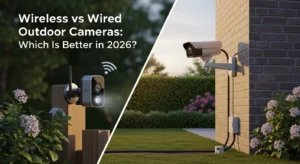
If you’ve ever climbed a ladder in the rain to recharge a battery-powered camera, you already know why solar-powered outdoor cameras have quietly become the smartest pick of 2026. They install in 15 minutes, never run out of power, and skip the battery swaps that make wireless cameras annoying.
I’ve been testing the best solar powered outdoor cameras across three different climates — high humidity, dry heat, and partial shade. Here are the five that genuinely live up to the marketing.
Why Solar-Powered Cameras Make Sense in 2026
Solar tech has matured fast. The panels on modern cameras are 30–40% smaller than those from three years ago, while delivering more power. Combined with improved battery efficiency, this means:
- No charging required. Just 4 hours of sun keeps most cameras running indefinitely.
- No wires to your home. Mount them on fence posts, garden walls, or remote corners.
- Lower long-term cost. No replacement batteries for 5+ years.
- Continuous operation. Even on cloudy days, internal batteries usually have 2–3 weeks of reserve.
Solar cameras are perfect for sheds, driveways, garden gates, and anywhere wiring is impractical.
1. Best Overall: Eufy SoloCam S340 (Dual Lens)
Eufy nailed this one. The S340 has two lenses — a wide and a telephoto — that work together to track subjects across a 360° pan-tilt range. The integrated solar panel keeps it running year-round, and AI tracking actually follows people as they move. No subscription needed (storage is on a microSD card), and the app is genuinely well-designed. Best for medium properties that need wide coverage.
2. Best Budget Pick: Reolink Argus 3 Pro (with Solar Panel)
Under ₹8,000 for camera + panel, the Argus 3 Pro is the sweet spot. 2K resolution, color night vision, and a 122° field of view. The solar panel cable is long enough to mount the camera in shade and the panel in sun — a feature most cheap solar cams skip. No monthly fees. This is the camera I’d recommend to a friend who’s never bought one before.
3. Best for Big Properties: Reolink Argus 4 Pro Solar
If your property is large or has multiple zones, the Argus 4 Pro is the move. 180° panoramic view from a single camera means one device can cover a porch, driveway, and front yard. 4K resolution, color night vision, and a built-in spotlight. Solar panel keeps it powered without monthly battery anxiety.
4. Best Stealth Pick: Ring Stick Up Cam Pro Solar
Ring’s solar option blends in better than most. Small, neutral colors, and a discreet solar panel that can be mounted nearby instead of attached directly to the camera. 1080p HDR, color night vision, and seamless integration with Alexa and other Ring devices. Slightly higher cost, but the design and ecosystem are top tier.
5. Best for Off-Grid Setups: Soliom S60
The S60 is built for cabins, farms, and off-grid properties. Larger battery, higher-output solar panel, and built-in 4G LTE option (so you don’t even need Wi-Fi). 1080p video, IP66 weatherproofing, and PIR motion sensors that filter out wind and small animals. If you need a camera in the middle of nowhere, this is it.
What to Look for in a Solar Camera
After testing all of these, here’s what actually matters:
- Detachable solar panel. Lets you mount the panel in sun while the camera sits in shade.
- Cable length. Look for at least 3 meters between camera and panel.
- Battery capacity. 8000+ mAh is the sweet spot — enough for 2–3 weeks without sun.
- Standalone storage. Local microSD recording skips the monthly cloud fee.
- AI motion filtering. Solar cameras work best when they only wake up for real events.
Common Mistakes With Solar Cameras
- Mounting the panel in shade. Even partial shade reduces output by 30–50%. The panel needs direct sun for at least 4 hours.
- Pointing the panel the wrong direction. In the Northern Hemisphere, point it south. In the Southern Hemisphere, north.
- Forgetting to clean the panel. Dust, leaves, and bird droppings can drop output by 25%. Wipe it down once a quarter.
- Treating solar like infinite power. Most solar cameras still benefit from a recharge every 6 months in winter — especially in the UK, Europe, or North India during cloudy seasons.
Where to Mount a Solar Outdoor Camera
The ideal spot is:
- 8–10 feet off the ground
- Solar panel facing the sun for 4+ hours daily
- Away from overhanging trees (leaves block the panel and the lens)
- Near common entry paths for the camera, not necessarily the panel
If you can’t find a spot with both good camera angle and good sun, mount the camera where you need it and run the panel cable to a sunny spot nearby.
Are Solar Cameras Worth It?
Honestly, yes — for most outdoor use cases. The math is simple:
- Battery camera: ₹6,000 + battery replacement every 2–3 years (₹500–₹1,500 each time)
- Wired camera: ₹6,000 + electrician install (₹2,000–₹5,000 once)
- Solar camera: ₹8,000–₹10,000 with panel, no recurring cost
Over five years, solar wins on total cost and convenience.
Final Thoughts
The best solar powered outdoor cameras in 2026 are genuinely better than battery-only or wired alternatives for most homes. The Eufy SoloCam S340 leads the pack overall, the Reolink Argus 3 Pro is the smart budget pick, and the Argus 4 Pro covers large properties beautifully.
Pick the one that fits your property, mount the panel in real sun, and you’ll never think about your camera again — which is the whole point of good security gear.