
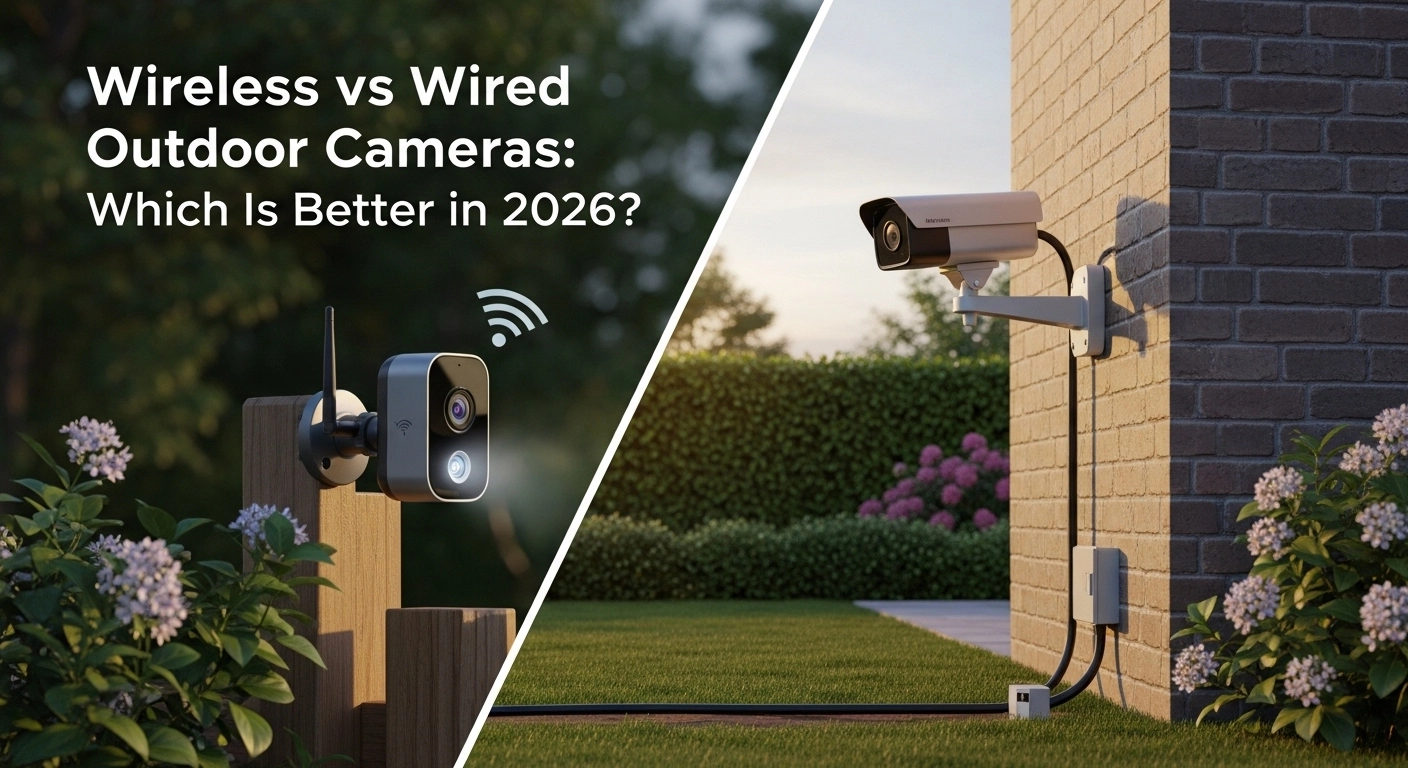
Walk into any electronics store and you’ll see the same thing: wireless outdoor cameras stacked in pretty boxes with phrases like “no wires, no hassle.” Then beside them, wired cameras in serious-looking packaging promising “professional-grade reliability.” Which is actually right for your home?
I’ve installed both at different houses, in different climates, and with different goals. The honest answer is that the wireless vs wired outdoor camera decision isn’t about which is better — it’s about which is better for your specific situation. Here’s a clear breakdown.
What “Wireless” and “Wired” Actually Mean
Most people misunderstand the terms.
- Wireless outdoor cameras run on rechargeable batteries (or solar) and transmit video over Wi-Fi. No cables of any kind. Examples: Arlo Pro 5S, Eufy SoloCam, Blink Outdoor 4.
- Wired outdoor cameras are plugged into a power outlet, but transmit video over Wi-Fi. They are not fully wired (which would mean Ethernet too). Examples: Nest Cam Outdoor, TP-Link Tapo C320WS, Ring Stick Up Cam Wired.
- PoE cameras are the most “wired” option — one Ethernet cable carries both power and video. Most reliable but require professional installation. Examples: Lorex E892AB, Reolink RLC-820A.
For most homes, the real choice is between battery wireless vs plug-in wired. PoE is for serious security setups.
Wireless Outdoor Cameras: Where They Win
- Place anywhere on your property. No outlets needed. Fence corners, gate posts, garden walls, treetops — all fair game.
- Easy DIY installation. Most are mounted in 10 minutes with screws or magnets.
- No power outage vulnerability. Even when the grid goes down, your camera keeps recording.
- Easy to relocate. Want to move it next month? Just unscrew it.
- Solar-compatible models exist that bypass the battery problem entirely.
Wireless Outdoor Cameras: Where They Lose
- Battery anxiety. Most claim 6 months but realistically last 2–4 with frequent motion alerts.
- Recording gaps. Battery cameras only record on motion, not continuously. The first 1–2 seconds of an event can get cut off as the camera “wakes up.”
- Cold weather drops battery life dramatically. A camera that lasts 6 months in summer might last 6 weeks in winter.
- Long-term cost is higher because of replacement batteries every 2–3 years.
Wired Outdoor Cameras: Where They Win
- Always on, always recording. No batteries to die, no wake-up lag.
- Continuous recording option for true 24/7 coverage.
- Better video processing because they have unlimited power.
- Higher resolution and HDR are easier with constant power.
- Lower long-term cost — no batteries to replace, no charging.
Wired Outdoor Cameras: Where They Lose
- Installation can be a project. Running wires through walls, sealing entry points, hiring an electrician — the install can cost more than the camera.
- Limited placement. You’re stuck within a few feet of an outlet (or wherever you can run conduit).
- Power outage vulnerability. When the electricity goes out, your camera goes too — unless you have a UPS backup.
- Cable visibility. Even with cable management, there’s a wire running somewhere.
Side-by-Side: Wireless vs Wired Outdoor Camera
| Factor | Wireless | Wired |
|---|---|---|
| Installation | DIY in 15 minutes | 1–2 hours, often needs help |
| Placement freedom | Anywhere | Near outlets only |
| Reliability | Good (battery dependent) | Excellent |
| Continuous recording | Rarely | Yes |
| Cold weather performance | Reduced | Unaffected |
| Power outage immunity | Yes | No (without UPS) |
| Long-term cost | Higher | Lower |
| Aesthetic | Clean | Cable visible |
Solar: The Hybrid Option Worth Considering
Solar outdoor cameras like the Eufy SoloCam S340 and Reolink Argus 4 Pro deserve a special mention. They’re technically wireless but skip the battery drama by recharging from sunlight. If your camera spot gets 4+ hours of sun a day, solar gives you the best of both worlds.
Which Should You Actually Buy?
Choose a wireless outdoor camera if:
- You can’t easily run cables to your camera spot.
- You want a 15-minute install with no drilling.
- You’d rather replace batteries occasionally than pay for installation.
- You want flexibility to move the camera later.
Choose a wired outdoor camera if:
- You want true 24/7 recording (not just motion clips).
- You have a nearby outlet or are building/renovating.
- You hate the idea of charging anything.
- You want the most reliable long-term solution.
Choose a solar outdoor camera if:
- Your spot gets good sunlight.
- You want zero ongoing maintenance.
- You’re tired of charging batteries on other devices.
The Real-World Recommendation
Most homes do best with a mix. A wired camera at the main entrance (where reliability matters most), and one or two wireless cameras at side gates or fence corners (where running cable is impractical).
If I had to pick a single setup for an average 3-bedroom home: One wired camera at the front door, two solar cameras covering the side gate and backyard. That covers the perimeter, eliminates battery anxiety in the high-traffic zone, and keeps the install simple.
Final Thoughts
The wireless vs wired outdoor camera debate isn’t really a debate — they solve different problems. Pick wireless when freedom matters more than reliability, wired when reliability matters more than convenience, and solar when you can have both.
Either way, place them well, secure your accounts, and your property will be safer than 90% of homes around you.