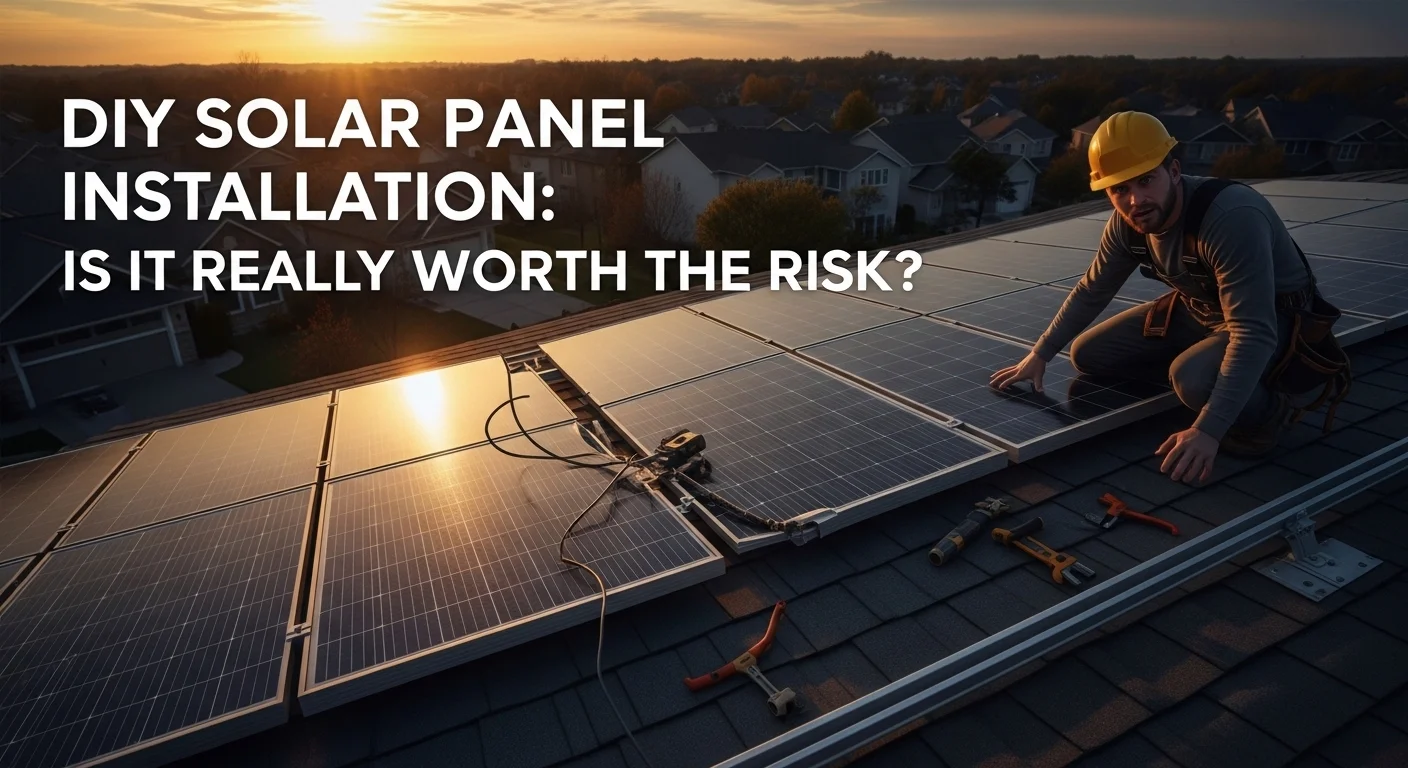
YouTube makes it look easy. A guy bolts some panels on a roof, plugs them into a converter, and his electric meter spins backwards. Comments full of “I saved ₹50,000 doing it myself!” Tempting, right?
Here’s the truth: DIY solar panel installation is technically possible, sometimes legal, and occasionally a great choice. But for most homeowners, it’s a financial trap that voids warranties, fails inspections, and leaves the roof leaking. This guide gives you an honest breakdown — not anti-DIY, not pro-installer, just real.
What “DIY Solar” Actually Means
There are three DIY solar tiers, and they’re very different:
- Off-grid DIY — You build a small system to power a shed, RV, or remote cabin. No grid connection. Legal almost everywhere. Genuinely doable.
- Off-grid backup DIY — You install solar with batteries to back up specific circuits in your home. Legal in most areas with proper permits.
- Grid-tied DIY — You install a full home system that connects to the utility grid. This is where most DIYers get into trouble. Almost everywhere requires licensed electrician sign-off, utility approval, and government inspection.
Most “I saved thousands” stories are about Tier 1. Almost none are about Tier 3.
What You’d Actually Need (Tier 3 Grid-Tied DIY)
If you’re trying to DIY a full home solar system, here’s what’s involved:
- Engineering plans — structural and electrical drawings stamped by a licensed engineer.
- Permits — building permit, electrical permit, and net metering application.
- Equipment — panels, inverter, mounting, wiring, breakers, disconnects, monitoring.
- Installation skills — roof work at height, electrical wiring at 240V or 600V DC, sealing penetrations correctly.
- Inspection — utility and government inspections before you can turn the system on.
- Net metering paperwork — utility approval to connect to the grid.
Cutting any one of these corners means the system either won’t work, won’t be legal, or won’t deliver the savings you expected.
The Real Cost Comparison
Let’s compare a 3 kW DIY install vs professional install in India:
| Cost Item | DIY | Professional |
|---|---|---|
| Panels (Tier-1) | ₹70,000 | ₹70,000 |
| Inverter | ₹35,000 | ₹35,000 |
| Mounting structure | ₹15,000 | ₹15,000 |
| Wiring + electrical components | ₹20,000 | (included) |
| Engineering and permits | ₹15,000 | (included) |
| Installation labor | DIY (your time) | ₹25,000 |
| Net metering and paperwork | ₹5,000 | (included) |
| Total cost | ~₹1,60,000 | ₹2,00,000 |
| Government subsidy eligibility | Often disqualified | Eligible (₹78,000) |
| Net cost after subsidy | ₹1,60,000 | ₹1,22,000 |
Notice the trick: DIY installations are often disqualified from the PM Surya Ghar subsidy because the system isn’t installed by an MNRE-empanelled vendor. After the subsidy, professional installation actually costs less.
When DIY Solar Actually Makes Sense
There are scenarios where DIY is clearly the right call:
- Off-grid sheds, cabins, or workshops — small systems with no grid connection.
- Boats and RVs — portable solar systems with self-contained battery banks.
- Backup-only systems — small solar generators powering a fridge or fan during outages.
- Educational projects — learning the technology without trying to power your home.
For these uses, DIY can save serious money and is genuinely satisfying. Just don’t try to scale it up to a grid-tied home system without help.
When DIY Solar Is a Disaster
The classic DIY solar failure stories all involve:
- Roof leaks — improper sealing of mount penetrations leads to water damage in 1–2 years.
- Fire risk — incorrect DC wiring on a 600V system can spark fires inside walls.
- Electrocution — DC arcing at 600V is more dangerous than AC at the same voltage.
- Voided warranties — most panel manufacturers void warranty if installed by an unlicensed party.
- Failed inspection — net metering rejected, system can’t feed power back to the grid.
- Insurance issues — homeowner insurance often won’t cover DIY-installed solar.
The Hybrid Approach (DIY + Pro)
A growing number of homeowners use a smart middle path:
- You buy the panels and equipment yourself (saving ~10–15%).
- A licensed installer handles the install, electrical, and permits.
- You handle ongoing monitoring and cleaning yourself.
This gives you the savings of DIY without the legal and safety risk. Many companies in India and the US offer “customer-supplied equipment” install services for this reason.
What You’d Need to Learn for Real DIY
If you’re set on DIY, expect to invest 40–80 hours learning:
- Electrical theory — DC vs AC, voltage drop, wire sizing, breaker rating
- Roof structure — load calculations, flashing, weatherproofing
- Code compliance — National Electrical Code (US) or IS standards (India)
- Inverter setup and configuration
- Net metering procedures in your specific area
- Permit and inspection requirements
If you don’t have an electrical or structural background, this is a big lift. There are great courses (Solar Energy International, Coursera Solar Energy specialization) but they require serious commitment.
Final Thoughts
DIY solar panel installation is rarely worth the risk for grid-tied home systems — the legal, financial, and safety hurdles eat most of the savings, and you lose subsidy eligibility on top. For sheds, cabins, RVs, and educational projects, DIY is fantastic. For your house, hire a vetted installer and use the time you’d have spent on YouTube tutorials to negotiate a better quote.
Solar is one of the few home upgrades that genuinely pays for itself. Just make sure it’s installed in a way that lasts 25 years — because that’s where the real savings are.